Imagine you wanted to find a new podcast to listen to.
The most likely move in 2026 is to ask your AI assistant something like “What’s a good true crime podcast?” or “Best business podcasts for entrepreneurs?” or “Podcasts about mindfulness?”
But what do these AIs recommend?
Over 4 weeks, we systematically queried four major AI assistants — ChatGPT (OpenAI), Claude (Anthropic), Perplexity, and Gemini (Google) — across 849 different podcast topics to create the first comprehensive map of AI podcast discovery.
The results challenge much of what we thought we knew about podcast visibility.
The AI Podcast Charts: A New Kind of Ranking
When we analyzed which podcasts AI assistants recommend most frequently, a clear hierarchy emerged:
| # | Overall |  ChatGPT ChatGPT |  Claude Claude |  Perplexity Perplexity |  Gemini Gemini |
|---|---|---|---|---|---|
| 1 |  The Tim Ferriss Show The Tim Ferriss Show |  Meditative Story Meditative Story |  How I Built This How I Built This | The Tim Ferriss Show | How I Built This |
| 2 | How I Built This |  The Diary Of A CEO The Diary Of A CEO | The Tim Ferriss Show | How I Built This | The Tim Ferriss Show |
| 3 |  Masters of Scale Masters of Scale | The Tim Ferriss Show | Masters of Scale |  WorkLife with Adam Grant WorkLife with Adam Grant | Masters of Scale |
| 4 |  Planet Money Planet Money | Masters of Scale |  The School of Greatness The School of Greatness | Masters of Scale | Planet Money |
| 5 |  The Mel Robbins Podcast The Mel Robbins Podcast |  Finding Mastery Finding Mastery |  Stuff You Should Know Stuff You Should Know | The Mel Robbins Podcast |  HBR IdeaCast HBR IdeaCast |
| 6 |  Entrepreneurs on Fire Entrepreneurs on Fire | How I Built This | The Mel Robbins Podcast | Planet Money |  99% Invisible 99% Invisible |
| 7 | The Diary Of A CEO |  Maintenance Phase Maintenance Phase | Entrepreneurs on Fire | Entrepreneurs on Fire |  Smart Passive Income Smart Passive Income |
| 8 | Stuff You Should Know |  TBPN TBPN | Planet Money |  The Happiness Lab The Happiness Lab |  Huberman Lab Huberman Lab |
| 9 | The School of Greatness |  The Daily The Daily |  On Purpose with Jay Shetty On Purpose with Jay Shetty |  The GaryVee Audio Experience The GaryVee Audio Experience |  My First Million My First Million |
| 10 | HBR IdeaCast |  Sleep With Me Sleep With Me | The Happiness Lab |  Radiolab Radiolab | Stuff You Should Know |
AI Podcast Rankings by Total Mentions — the more topics a show gets recommended for, the higher it ranks.
The Tim Ferriss Show doesn’t appear on any top podcast platform chart. On Apple’s US Business chart — his own category — he’s #35. On Spotify’s, #18.
By traditional metrics, he’s a mid-tier business podcast. But in AI recommendations? He’s #1 overall. Top 4 on ChatGPT, Claude, Perplexity, and Gemini. Every single one.
AI, it seems, has different taste than the general listening public.
Traditional charts measure downloads. AI measures something else entirely: web presence, editorial coverage, and citation authority.
The Surprising Truth: AI Assistants Mostly Disagree
Perhaps our most striking finding: AI assistants recommend different podcasts 71% of the time.
For every podcast-topic combination we tracked, we looked at how many of the four AI assistants mentioned it:
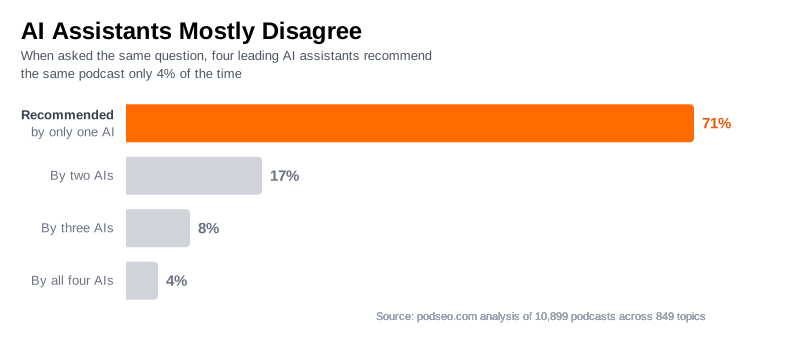
Only 4% consensus. That means when you ask ChatGPT, Claude, Perplexity, and Gemini the same question, they’ll give you mostly different answers.
This fragmentation creates an interesting landscape: 10,899 unique podcasts appeared in AI recommendations during our analysis, spread across 849 topics.
Each AI has developed its own “taste” — and they rarely agree.
Which AI Discovers the Most Podcasts?
Each AI assistant has a distinct personality when it comes to recommendations:
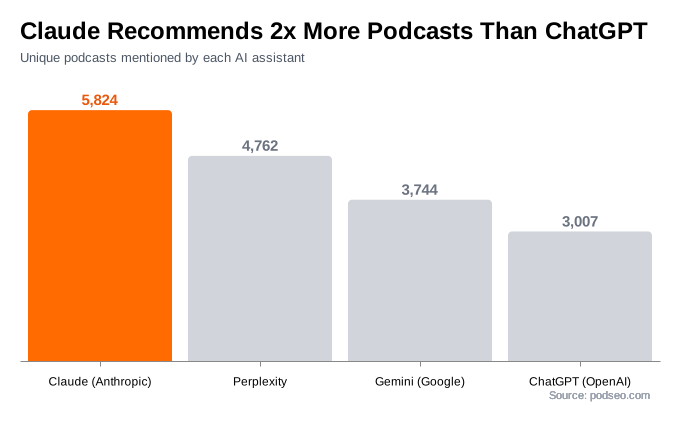
- Claude (Anthropic): Most generous. Recommends broadly
- Perplexity: Web-search focused
- Gemini (Google): Middle ground
- ChatGPT (OpenAI): Most selective. Curated recommendations
Claude mentions nearly twice as many unique podcasts as ChatGPT. If you’re a smaller podcast hoping for AI visibility, your odds are significantly better with Anthropic’s assistant than OpenAI’s.
Where Do AI Assistants Get Their Information?
This might be the most actionable finding for the podcast industry: 79% of AI podcast recommendations cite listicle and aggregator sites, not the podcast platforms themselves.

Top 10 Sources Cited by AI (covering 37% of the total):
| Source | Citations | Type |
|---|---|---|
| Feedspot | 10.8% | Editorial |
| Player FM | 6.8% | Platform (curated) |
| Apple | 6.5% | Platform |
| Goodpods | 3.8% | Platform (curated) |
| Wikipedia | 2.7% | Editorial |
| Spotify | 1.8% | Platform |
| The Investors Podcast | 1.4% | Editorial |
| Podcast Review | 1.4% | Editorial |
| Podcastle | 1.3% | Editorial |
| Million Podcasts | 1.2% | Editorial |
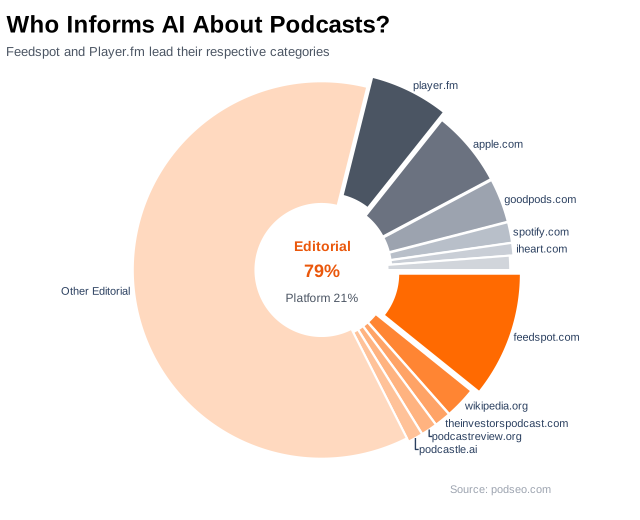
Apple Podcasts and Spotify — the two dominant listening platforms — account for just 8.3% of AI citations combined.
Meanwhile, Player FM and Goodpods — hybrid platforms that combine listening with strong editorial curation and “best of” lists — together account for 10.6%, more than Apple and Spotify combined.
AI systems favor editorial context — curated lists, reviews, and recommendations. That’s why Player FM and Goodpods (platforms with strong curation) get cited more than Apple and Spotify combined.
But platform SEO still matters: AI shapes what listeners search for, but platforms are where they actually find and subscribe. The podcasts winning today are visible in both layers — recommended by the sources AI trusts, and discoverable on the platforms where listeners hit play.
Topic Diversity: From Mainstream to Niche
Our 849 topics span both mainstream genres and highly specific niches.
Mainstream topics — where AI recommends the most diverse range of podcasts — include some expected categories (with a few surprises):
- Long Drive — 135 podcasts
- Christian Living — 119 podcasts
- True Crime — 111 podcasts
- Students — 107 podcasts
- Commuting — 104 podcasts
But the real opportunity may be in the long tail. AI surfaces recommendations for highly specific audiences that rarely appear on traditional charts:
Top niche topics (Long-tail):
- TTRPG Actual Play — 61 podcasts
- Women in STEM — 52 podcasts
- Healthcare Leadership — 47 podcasts
- Travel Hacking — 46 podcasts
- Law Education — 46 podcasts
- Erotica — 46 podcasts
- Hip Hop Culture — 42 podcasts
- Star Wars Galaxy — 39 podcasts
This is where AI discovery may matter most.
For niche podcasts that struggle to break into traditional charts, AI recommendations offer an alternative path to their target audience.
What This Means for the Podcast Industry
The rise of AI-powered podcast discovery creates both opportunities and challenges:
For Podcasters:
- Discovery now happens in two layers — AI shapes which podcasts listeners hear about; platforms are where they search, subscribe, and listen. The podcasts winning today are visible in both.
- Editorial visibility matters more than ever — AI systems favor curated lists, reviews, and recommendations. Presence on listicle sites and podcast directories now directly impacts discoverability.
- Each AI is a separate audience — optimizing for one doesn’t guarantee visibility on others. Track your AI visibility as a new metric alongside downloads and chart position.
For Advertisers:
- The podcasts AI recommends may differ significantly from those dominating traditional charts
- AI-recommended shows may reach different (potentially more targeted) audiences
- “AI Visibility Score” could become a new metric for sponsorship decisions
For Platforms:
- Apple and Spotify’s direct influence on AI recommendations is surprisingly limited — but they remain where listeners ultimately convert
- Third-party aggregators and curated platforms (like Player FM and Goodpods) punch above their weight in AI discovery
- The winners are podcasts visible in both layers: discoverable on platforms and cited by the editorial sources AI trusts
The Rise of GEO: Generative Engine Optimization
Just as SEO became essential for web visibility, GEO — Generative Engine Optimization — is becoming essential for podcast growth.
GEO means optimizing for the AI systems that increasingly shape how people discover podcasts.
This is the first comprehensive data showing what drives those recommendations — and which podcasts appear when listeners ask ChatGPT for “best podcasts about [topic].”
For podcasters looking to grow their audience, the path is now two-fold: get recommended by AI (through presence on the editorial sites and directories AI trusts), and be findable when that listener searches — whether by your name, your topic, or the keywords that define your show.
One without the other leaves downloads on the table.
Podcasters who optimize for both AI visibility and platform discoverability are the ones most likely to emerge from the crowd.
This analysis was conducted by PodSEO, which offers GEO (Generative Engine Optimization) tracking for podcasters.
Data collected December 6, 2025 – January 2, 2026, across 849 topics and 4 AI providers.