
At Podseo we look holistically at how podcasts show up in the platforms. In addition to all the intel we have relative to keywords, we also consider the contribution of other podcasts in your space. This is reflected in several features of our product such as all competitor-related ones (competitor finder and competitor tracker) but also intel on what platforms consider podcasts somehow connected to yours.
These are all opportunities: cross promotions like being a guest on someone else’s podcast in exchange for inviting them to yours, or feed drops—allowing a teaser of another podcast to be an “episode” of your podcast—have been proven to have an effect in increasing audience.
The podcast page in the two biggest platforms for consuming podcasts, Apple Podcasts and Spotify, have a specific section dedicated to related podcasts: “Listeners Also Liked” on Apple and “You Might Also Like” on Spotify. Our “referral podcasts” feature shows the other podcasts where yours appears in these sections.
What is the behavior of the algorithms that fill these sections in the two platforms? We ran an analysis on Apple Podcast recommendations relative to podcasts in English that released at least one episode in the last 6 months, and here’s what we found.
The Reality Check: You’re Not Behind
Let’s start with an encouraging truth that might surprise you: 56.3% of active English podcasts don’t appear in any recommendation sections yet. That’s 148,503 podcasts out of the 263,859 active shows we analyzed. If your podcast isn’t showing up in anyone’s “Listeners Also Liked” section, you’re actually in the majority.
Even more interesting: we found 77,459 podcasts that are making recommendations but not receiving any in return. These shows are recognized enough by the algorithm to recommend others, but haven’t yet built the listening patterns needed to be recommended themselves. This is a normal part of the growth journey.
What This Means for You
Being in the “no recommendations” group isn’t a disadvantage—it’s an opportunity. You have:
- A clean slate to position yourself strategically
- Less competition in emerging niches
- The ability to build authentic connections from the ground up
- Room to grow without being boxed into existing categories
The 15-Spot Constraint: Understanding the Asymmetry
One of the most important findings from our analysis is the built-in asymmetry of Apple’s recommendation system. Every podcast can recommend a maximum of 15 other shows, but there’s no limit to how many times a podcast can be recommended.
This creates a fascinating dynamic:
- Popular podcasts like “The Diary of a CEO” receive 4,129 recommendations
- “The Ezra Klein Show” appears in 6,157 different recommendation sections
- Meanwhile, these mega-shows can only recommend 15 others back
Why This Asymmetry Matters
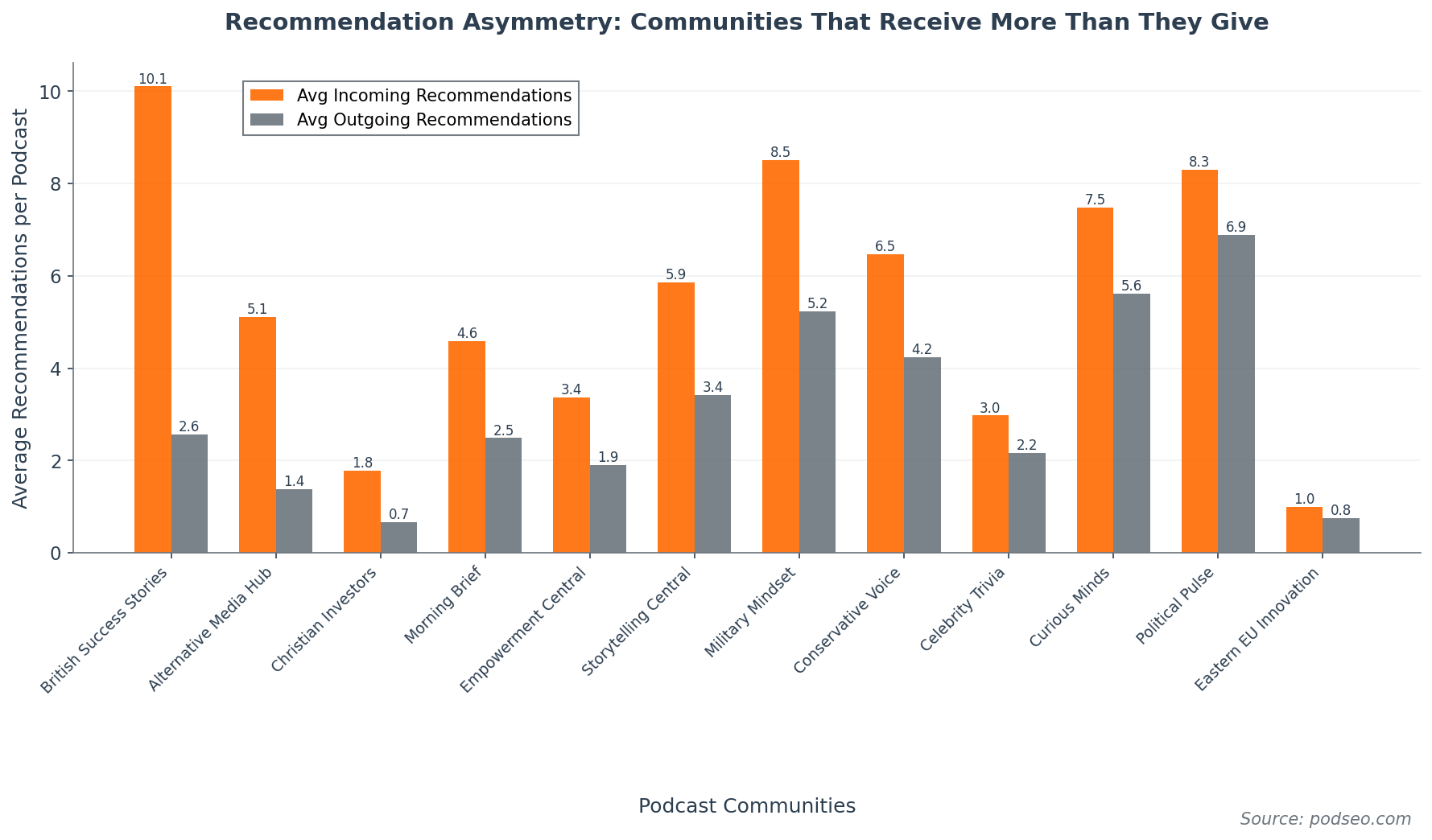 Some communities receive far more recommendations than they give—creating natural hierarchies and collaboration opportunities
This constraint creates natural hierarchies and opportunities:
- Getting into the Top 15: When a popular podcast adds you to their 15 recommendations, you gain exposure to their entire recommendation network
- The Compound Effect: Once you appear in multiple recommendation lists, the algorithm notices these patterns
- Quality Over Quantity: It’s better to be genuinely recommended by 10 aligned podcasts than randomly mentioned by 100
Discovering Your Tribe: 149 Distinct Podcast Communities
Through advanced network analysis of 720,113 recommendation connections, we identified 149 distinct audience clusters. These aren’t just category groupings—they’re actual listening communities with shared behaviors and interests.
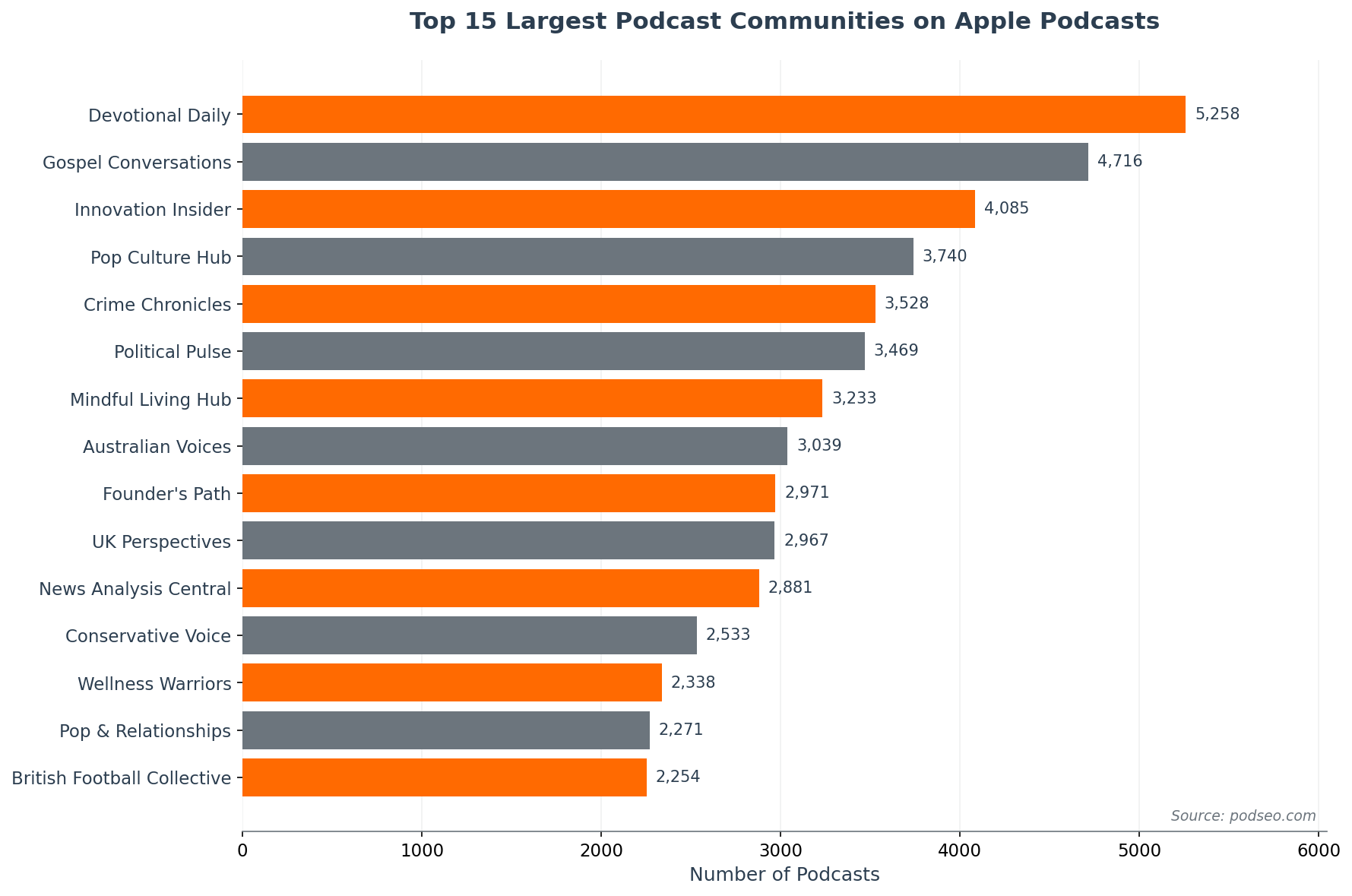 The 15 largest podcast communities on Apple Podcasts, each representing a distinct listening tribe with shared interests
The Major Tribes We Found
1. Faith & Spirituality Communities (3 major clusters, ~12,000 podcasts)
- Gospel Conversations (4,716 podcasts): Protestant/Evangelical community
- Devotional Daily (5,258 podcasts): General Christian and family content
- Sacred Traditions (1,265 podcasts): Catholic and traditional Christianity
- Top shows: The Bible Recap, Timothy Keller Sermons, The Briefing
2. Innovation Insider (4,085 podcasts)
- Business and technology convergence community
- Average of 7.0 incoming recommendations per show
- High cross-pollination between business and tech content
- Top shows: All-In Podcast, Hard Fork, The Journal
3. Crime Chronicles (3,528 podcasts)
- True crime and mystery community
- Extremely loyal audience with minimal cross-cluster listening
- Average of 6.0 recommendations per show
- Top shows: Crime Junkie, Dateline NBC, 48 Hours
4. Political Pulse (3,469 podcasts)
- News and political analysis community
- Highest engagement with 8.3 average incoming recommendations
- Strong liberal-conservative subclusters
- Top shows: The Ezra Klein Show, Fresh Air, NPR Politics
Niche Tribes: Where Opportunity Lives
Beyond the major clusters, we discovered fascinating niche communities:
- British Football Collective (2,254 podcasts): UK football/soccer with intense loyalty
- Pop & Relationships (2,271 podcasts): Dating, reality TV, and pop culture
- Rural Roots (732 podcasts): Farming, agriculture, and rodeo - small but incredibly tight-knit
- Tabletop Tales (1,255 podcasts): D&D and tabletop gaming - cross-promotes heavily within the community
- Racing Circuit (896 podcasts): Motorsports and automotive enthusiasts
The Power of Mutual Connections
One of our most actionable findings: 35,218 podcast pairs have mutual recommendations—they recommend each other. These bidirectional connections are gold for understanding collaboration potential.
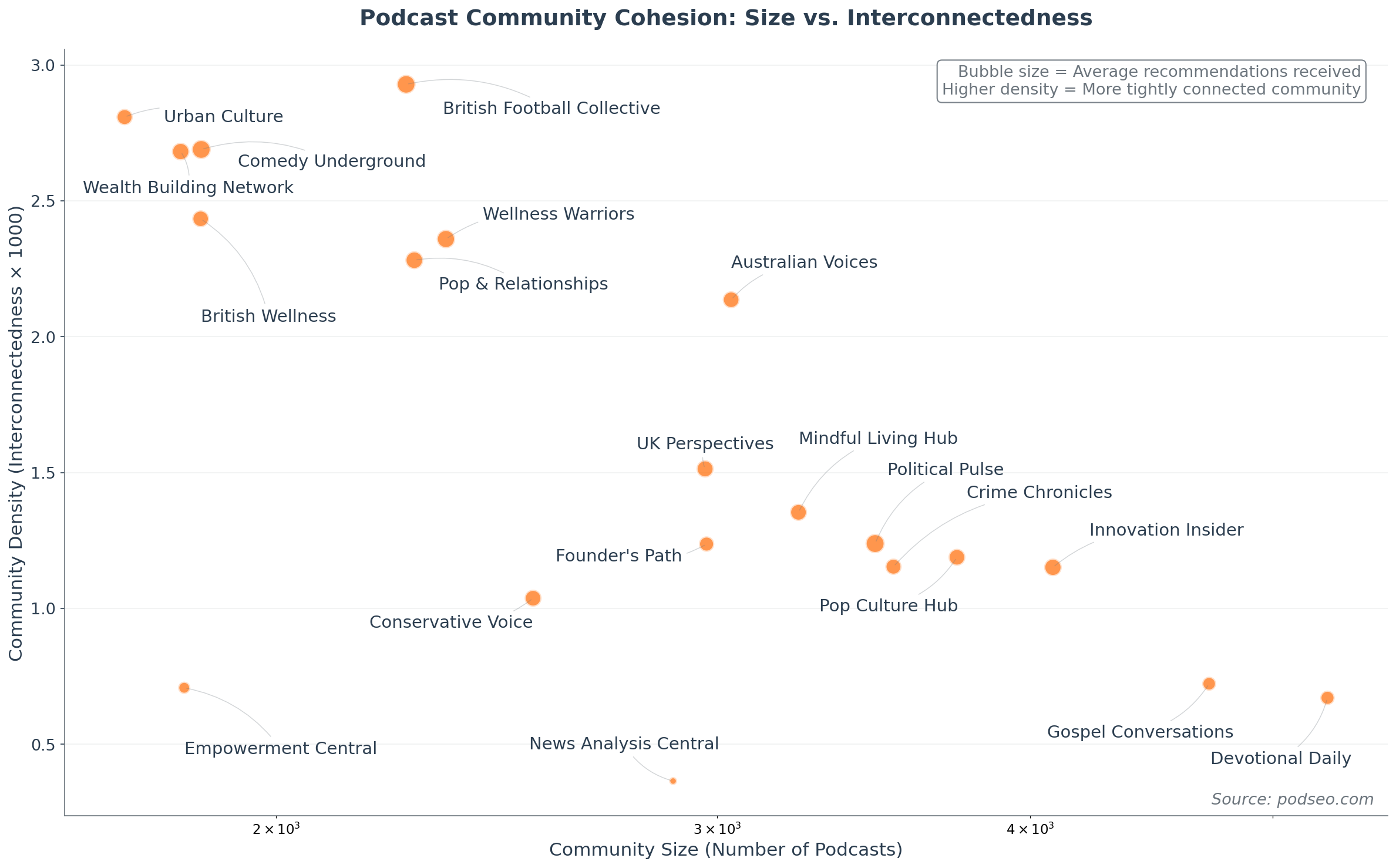 Larger bubbles indicate communities with more recommendations per podcast. Higher density shows tighter-knit communities where podcasts frequently recommend each other
What Mutual Recommendations Tell Us
When two podcasts recommend each other, it signals:
- Audience Overlap: Their listeners actively enjoy both shows
- Content Compatibility: The shows complement rather than compete
- Collaboration Success: Guest swaps between these shows yield higher conversions
- Algorithm Recognition: The platform sees these as related content
Finding Your Mutual Matches
Look for podcasts that:
- Share your category but aren’t direct competitors
- Have similar episode frequency and format
- Target the same audience demographic but from different angles
- Are at a similar growth stage (within 2x of your download numbers)
Actionable Strategies Based on the Data
Strategy 1: Map Your Position in the Ecosystem
First, understand where you fit:
- What type of content community does your podcast naturally align with?
- Are you in the 56.3% without recommendations, or the 43.7% in the network?
- Who are the hub podcasts in your space and what makes them successful?
- What patterns do you see in podcasts that your audience also enjoys?
Strategy 2: Build Strategic Relationships
Based on our analysis, here’s how to approach collaborations:
If You Have No Recommendations Yet:
- Identify 5-10 podcasts in your target cluster
- Engage authentically with their content
- Propose value-first collaborations
- Focus on podcasts just ahead of you in growth
If You’re Already in the Network:
- Analyze who’s recommending you
- Identify gaps—who should be recommending you but isn’t?
- Look for mutual recommendation opportunities
- Study what your recommenders do well
Strategy 3: Leverage Cross-Cluster Opportunities
Some podcasts act as bridges between communities. For example:
- Business podcasts that incorporate spirituality
- True crime shows with comedy elements
- Tech podcasts with social justice angles
These bridge positions are powerful for audience growth.
Strategy 4: Content Intelligence Mining
Your recommendation network is a content goldmine:
- What topics trend in your cluster?
- Which episode formats get the most engagement?
- What gaps exist that you could fill?
- Which keywords are your neighbors ranking for?
The Growth Journey: From Zero to Hub
Based on our data, here’s the typical podcast growth trajectory:
Stage 1: Foundation (0 recommendations)
- 56.3% of podcasts are here
- Focus: Consistent publishing, niche clarity
- Goal: 20-30 quality episodes
Stage 2: Recognition (Outgoing only)
- ~30% of podcasts
- The algorithm starts categorizing you
- Goal: First incoming recommendations
Stage 3: Network Member (Bidirectional)
- ~15% of podcasts
- Both making and receiving recommendations
- Goal: Build mutual connections
Stage 4: Cluster Influencer (High incoming)
- Top 5% of podcasts
- 50+ incoming recommendations
- Become a tastemaker in your niche
Stage 5: Hub Status (Cross-cluster influence)
- Top 1% of podcasts
- 500+ recommendations
- Bridge multiple communities
Beyond Competition: The Collaboration Economy
Our analysis reveals that the most successful podcasts don’t compete—they collaborate. The recommendation algorithm rewards this behavior by surfacing shows that complement each other.
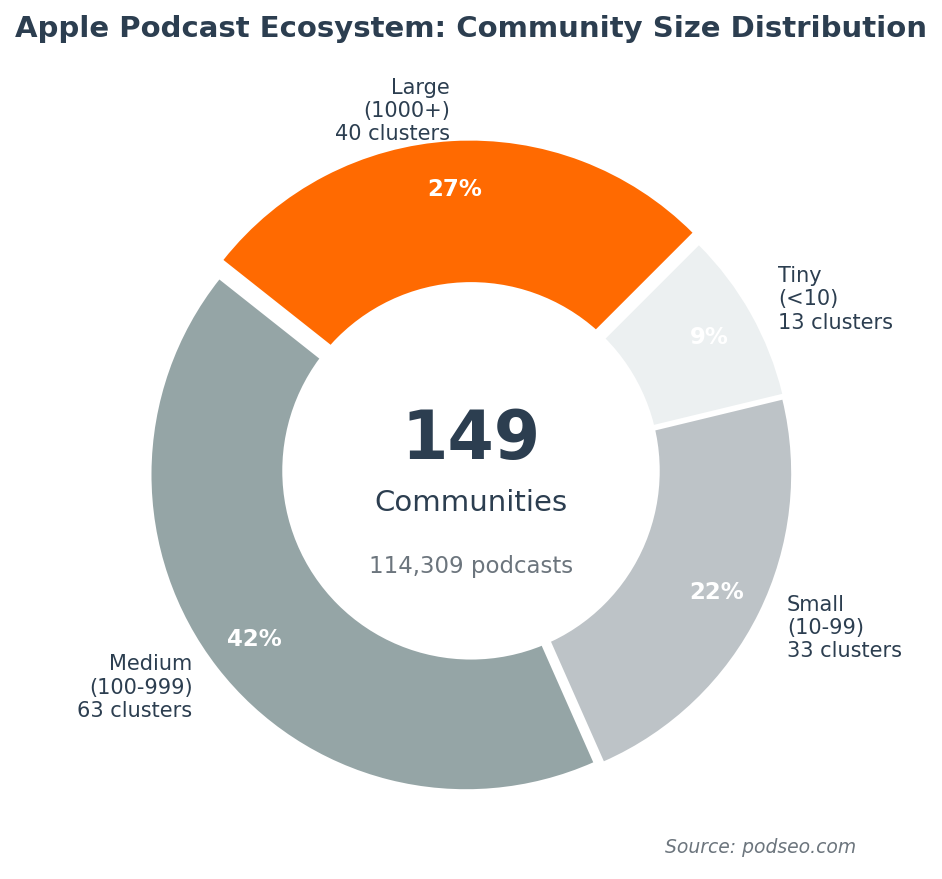 The Apple Podcast ecosystem contains 149 distinct communities ranging from massive networks to intimate niches
Practical Collaboration Tactics
Guest Swapping Within Your Cluster:
- 3-5x higher conversion than random outreach
- Audience already primed for your content
- Natural cross-promotion opportunities
Feed Drops with Mutual Recommendations:
- Highest success rate with bidirectional connections
- Test with 30-second teasers first
- Track which shows drive the most conversions
Content Partnerships:
- Co-create series with cluster neighbors
- Share research and resources
- Cross-promote on social media
Conclusion: Your Podcast’s Hidden Network Awaits
Knowing the podcasts related to yours lets you understand your audience better, helping position your podcast in the space, find topics relevant to your audience, and discover exchange opportunities with podcasts similar to yours (guest swapping, feed drops).
The data is clear: success in podcasting isn’t just about keywords and SEO—it’s about understanding your place in the larger ecosystem. Whether you’re in the 56.3% without recommendations or already a cluster hub, there are strategic moves available to accelerate your growth.
At Podseo, we don’t just show you keywords; we reveal your entire competitive landscape:
- Your recommendation network and how it’s evolving
- Which podcasts represent collaboration opportunities
- What content gaps exist in your cluster
- How to position yourself for algorithm visibility
The podcast ecosystem is more interconnected than ever. Understanding these connections—and leveraging them strategically—is what separates podcasts that plateau from those that thrive.
Ready to discover your podcast’s hidden network? Podseo tracks all of this and more, giving you the intelligence needed to make strategic decisions about your podcast’s growth.
This analysis examined 263,859 active English-language podcasts, mapped 720,113 recommendation connections, and identified 149 distinct audience communities on Apple Podcasts. Data current as of March 2024.