You’ve been told to share your Spotify link everywhere. Put it in your Instagram bio. Add it to your email signature. Make it easy for people to listen.
But is that what actually works for getting press coverage?
We analyzed 655,000 editorial podcast placements across 29,000+ domains to find out what journalists, bloggers, and high-authority publications actually link to when they mention podcasts.
The results might change how you think about podcast promotion.
The Big Finding: High-Authority Sites Link to Websites, Not Platforms
When we segmented placements by domain authority, a clear pattern emerged. (Domain authority here is a 0-100 score that broadly tracks how much editorial weight a site carries, roughly correlated with public traffic and reach signals. Wikipedia, NPR, and Forbes sit at the high end; small personal blogs sit at the low end.)
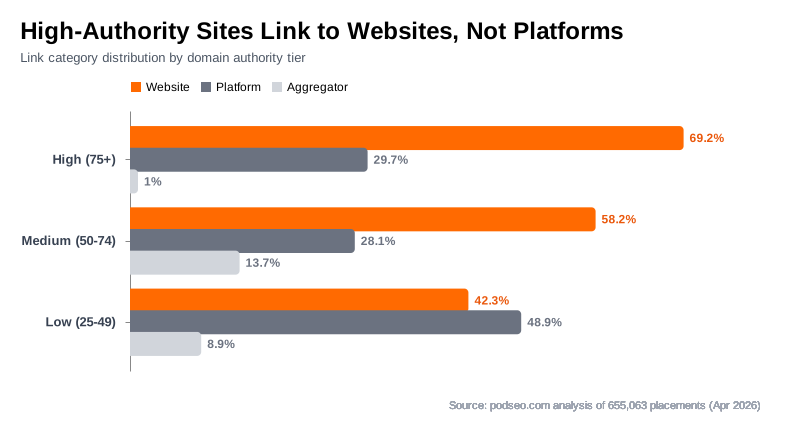
The higher the domain authority, the more likely they link to your podcast’s website.
- High authority (75+): 69.2% link to websites
- Medium authority (50-74): 58.2% link to websites
- Low authority (25-49): 42.3% link to websites
Wikipedia, NPR, Forbes, Time, The Guardian, and similar publications overwhelmingly link to podcast websites instead of Spotify or Apple Podcasts pages.
Meanwhile, aggregator links (pod.link, Linktree) virtually disappear at high-authority sites, accounting for just 1% of placements. The tools podcasters use to make sharing “easier” aren’t what journalists prefer.
At the low-authority tier, the picture inverts: platform links (48.9%) narrowly edge out website links (42.3%). Smaller blogs and personal sites still default to dropping in a Spotify or Apple link. Editorial standards rise with domain authority.
The Wikipedia Effect: Only 0.025% of Podcasts Make It
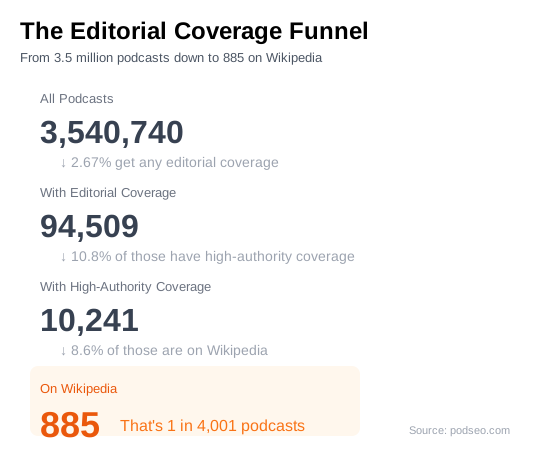
Of the 3.5 million podcasts in our database, only 885 have a Wikipedia page.
That’s 0.025%, or roughly 1 in 4,000 podcasts.
These 885 podcasts represent the absolute elite of editorial recognition. They include shows like:
- Conan O’Brien Needs A Friend
- Lore
- Heavyweight
- The Dropout
- Serial
- WTF with Marc Maron
And here’s what’s interesting about Wikipedia-featured podcasts: they have an even stronger website-link pattern than the general high-authority average.
| Metric | Wikipedia Podcasts | All Podcasts |
|---|---|---|
| Website links | 69.5% | 45.8% |
| Platform links | 23.9% | 42.5% |
| Hosting links | 0.1% | 7.6% |
| Aggregator links | 6.5% | 4.1% |
Podcasts that achieve Wikipedia-level recognition tend to have strong website presences. Correlation isn’t causation, but it’s a pattern worth noting.
The Concentration Problem: Top 1% Gets 19% of Coverage
Editorial coverage isn’t evenly distributed. It follows a power law.
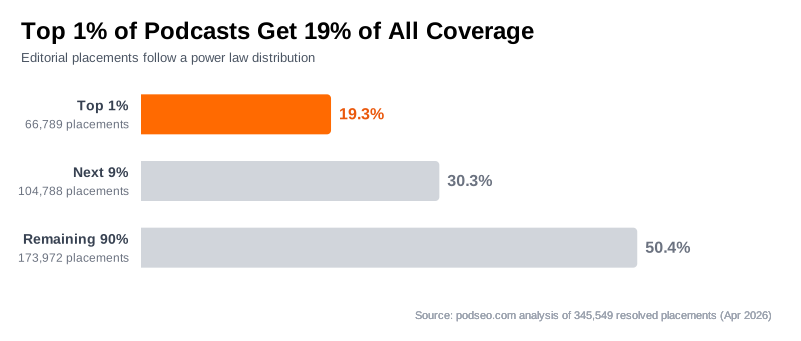
- Top 1% of podcasts (945 shows) receive 19.3% of all placements
- Top 10% of podcasts receive 49.7% of all placements
- 41.3% of podcasts with any coverage have just one placement
The median podcast with editorial coverage has only 2 placements. The most-cited mainstream show in our dataset is The Daily by NYT with 542 placements, followed by The Tim Ferriss Show (481) and How I Built This (412).
This creates a “rich get richer” dynamic. Podcasts like The Tim Ferriss Show, Huberman Lab, and How I Built This appear across dozens of high-authority domains. Each new placement increases their discoverability and likelihood of future coverage.
Episode Links Are Surprisingly Rare
Here’s something podcasters might not expect: only 7.9% of editorial placements link to specific episodes.
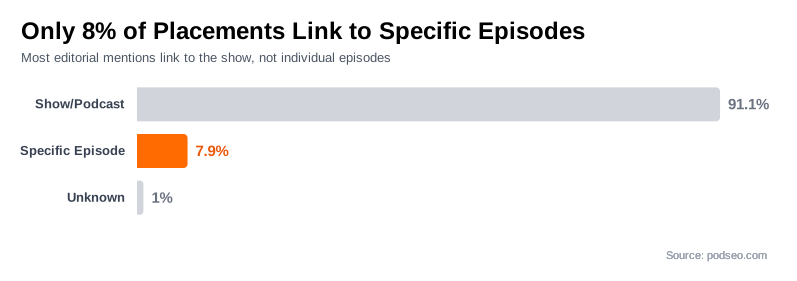
The vast majority (91.1%) link to the show itself, not individual episodes.
This has implications for content strategy. The common advice to create “shareable episode content” assumes journalists will link to episodes. They mostly don’t.
The exceptions are interesting:
- Castro: 92% episode links
- Megaphone: 60% episode links
- Spreaker: 57% episode links
- YouTube: 25% episode links
- Apple Podcasts: 3.4% episode links
These platforms seem to encourage or surface episode-level sharing in ways the major platforms don’t.
The Coverage Gap: Only 2.67% of Podcasts Get Featured
Perhaps the most sobering finding: only 2.67% of podcasts have any editorial coverage at all.
Of 3.5 million podcasts:
- 94,509 have at least one editorial placement
- 10,241 have high-authority (75+) placements
- 885 have Wikipedia mentions
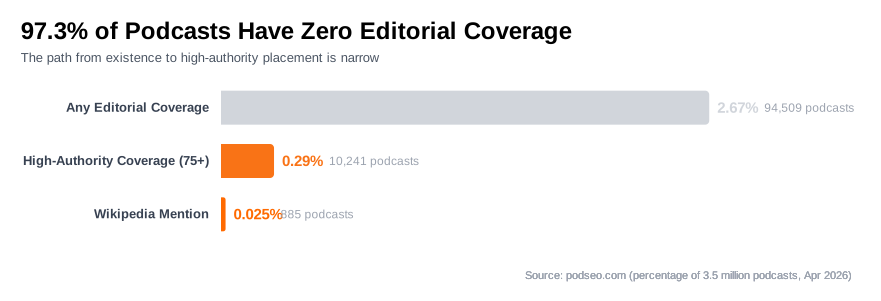
This means 97.33% of podcasts have zero editorial visibility in our dataset. They exist in a kind of “dark matter,” discoverable only through platform search, word of mouth, or social media.
For the 2.67% that do get covered, the path to high-authority placement is narrow:
- Only 10.8% of podcasts with any placements have high-authority coverage
- That’s 0.29% of all podcasts
Which High-Authority Sites Cover the Most Podcasts?
The domains covering the most unique podcasts reveal where editorial attention concentrates. We filtered the raw leaderboard to outlets that publish original editorial content, excluding user-generated platforms (Quora), product directories (Amazon), open-source code repositories (GitHub), and personal-blog hosts (Medium). Those domains technically score high on domain authority, but their podcast mentions are typically community-curated lists rather than journalism.
| Domain | Unique Podcasts | Authority Score |
|---|---|---|
| Wikipedia | 885 | 85 |
| iNews (UK) | 187 | 90 |
| Wired | 173 | 95 |
| Forbes | 154 | 85 |
| The Guardian | 144 | 92 |
| Oprah Daily | 144 | 85 |
| IMDB | 135 | 95 |
| NPR | 127 | 92 |
| Time | 108 | 88 |
| Muck Rack | 104 | 90 |
NPR naturally covers its own shows heavily, but also features a diverse range of podcasts. Forbes and Time focus on business and culture podcasts respectively. IMDB covers podcast adaptations and entertainment shows.
What This Means for Podcasters
1. Your Website Matters More Than You Think
High-authority publications link to websites 69% of the time. If you don’t have a professional podcast website, you’re missing the link format that prestigious publications prefer.
This doesn’t mean platform links are useless. They’re essential for listener conversion. But for earning press coverage, your website is often what gets linked.
2. Coverage Is Extremely Competitive
With only 2.67% of podcasts getting any editorial coverage, and 0.29% getting high-authority coverage, the competition is fierce. Standing out requires more than good content. It requires deliberate visibility work.
3. The Rich Get Richer
Top podcasts accumulate placements faster than newcomers. Breaking into editorial coverage likely requires proactive PR outreach, not just waiting to be discovered.
A Realistic Strategy for Independent Podcasters
Let’s be honest: pitching Forbes, NPR, or Time Magazine isn’t a viable strategy for most independent podcasters. These publications cover established shows with large audiences or newsworthy stories.
But here’s the good news: the podcast recommendation ecosystem is growing fast.
The Rise of Podcast Newsletters and Curators
A thriving ecosystem of podcast-focused newsletters, blogs, and recommendation sites has emerged, and they’re actively looking for shows to feature:
- Podcast newsletters (Substack, Beehiiv) with dedicated audiences seeking new shows
- Niche recommendation sites covering specific genres (true crime, business, comedy)
- Podcast review blogs that regularly feature independent creators
- Industry publications covering the podcasting space
These outlets may have lower domain authority than Forbes, but they have something more valuable: engaged audiences specifically looking for podcast recommendations.
A feature in a podcast newsletter with 5,000 subscribers who are actively seeking new shows can drive more listeners than a mention in a general-interest publication with millions of readers who aren’t in “podcast discovery mode.”
Why This Matters More in the AI Era
There’s a second, less obvious reason editorial placements are worth chasing: they’re increasingly what AI assistants read when someone asks for a podcast recommendation. In our analysis of what ChatGPT, Claude, Perplexity, and Gemini actually cite, 79% of AI podcast recommendations traced back to listicle and aggregator sites rather than Spotify or Apple. Apple and Spotify combined accounted for just 8.3% of AI citations.
So a single feature on a genre-specific newsletter or “best podcasts about X” blog isn’t just a one-time traffic bump. It’s an editorial signal that can keep surfacing you in AI answers for months, to listeners who never saw the original article.
HARO: The Long Game
HARO (Help A Reporter Out) and similar services connect journalists with expert sources. While not podcast-specific, they offer a path to mainstream coverage:
- Journalists post queries seeking expert commentary
- If a query aligns with your podcast’s topic, you can pitch yourself as a source
- Getting quoted often leads to a link back to your show
This is a longer-term strategy. You won’t land coverage overnight. But consistently responding to relevant queries builds relationships with journalists and establishes you as a go-to source in your niche.
The key: respond only when the query genuinely fits your expertise. Quality pitches beat quantity.
Finding the Right Outlets
The challenge isn’t that opportunities don’t exist. It’s finding them. Which newsletters cover your genre? Which blogs are actively reviewing shows? Who’s writing “best podcasts about X” lists?
This is exactly why we built the PR Visibility and Outreach features in PodSEO. They help podcasters:
- Discover newsletters, blogs, and recommendation sites relevant to their show’s category
- Track which outlets are actively featuring podcasts in their niche
- Manage outreach with a built-in pipeline from identification to featured placement
- Monitor when and where their podcast gets mentioned
Instead of manually searching for opportunities, you can see which outlets are already covering shows like yours and pitch them directly.
Methodology
This analysis examined 655,063 podcast placements discovered across 187,757 webpages on 29,438 unique domains. Placements were surfaced by systematically scanning RSS feeds, curated podcast directories, Google Alerts, Reddit discussions, and direct domain crawls.
Each link was classified into one of four categories (website, platform, hosting, aggregator) and, where possible, resolved to a specific podcast and episode. Domain authority was scored on a 0-100 scale using a combination of public traffic and reach signals plus a curated layer for well-known publications. Social media domains (Instagram, X, LinkedIn, Reddit, TikTok) were excluded from the analysis since they’re user-posted rather than editorial.
This analysis was conducted by PodSEO, which tracks editorial placements and PR visibility for podcasters.
Data snapshot: April 2026. Analysis covers 3.5 million podcasts and 655,063 editorial placements.