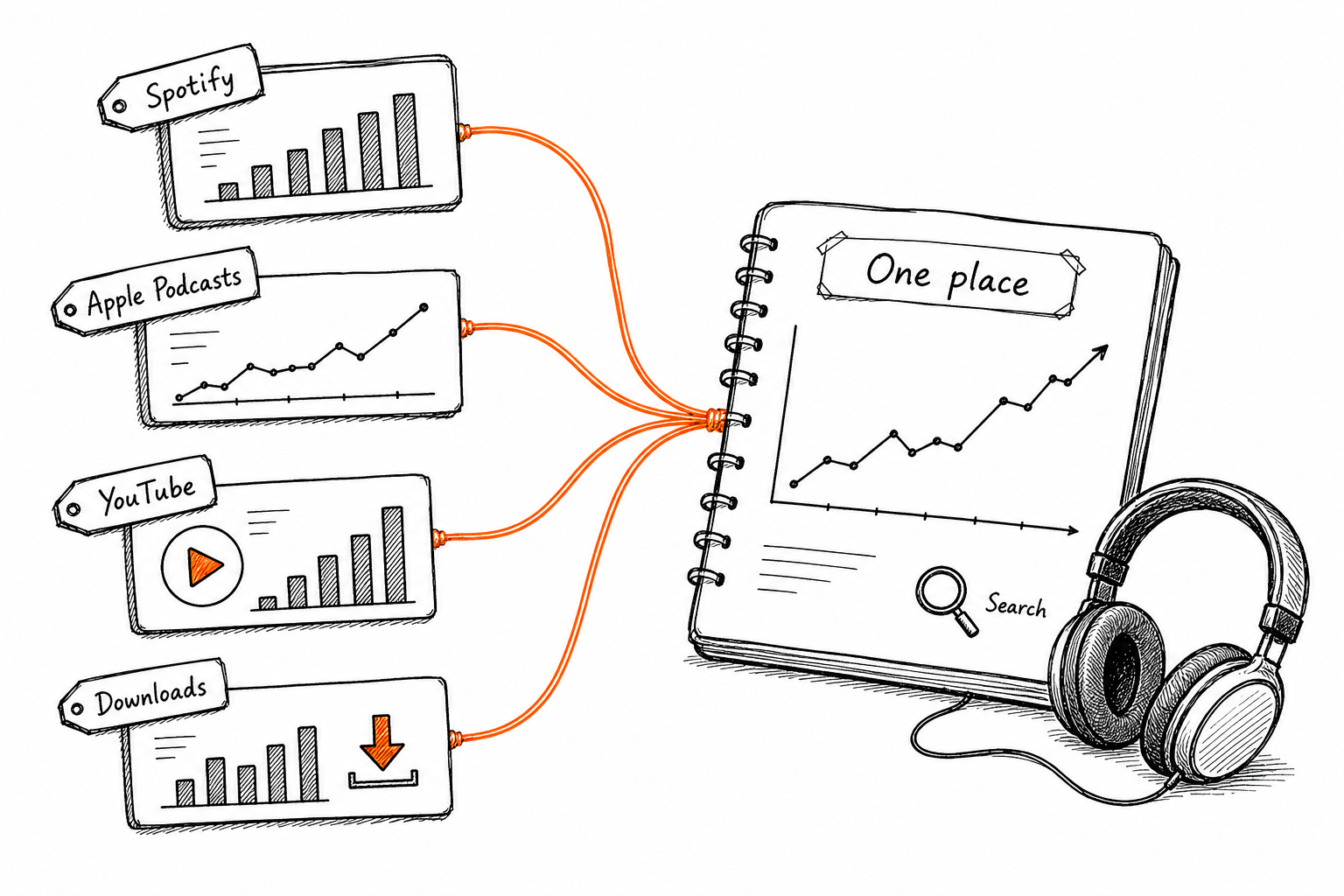
Your podcast’s numbers live in four or five places. Spotify for Creators has your plays and how people find you. Apple Podcasts Connect has listeners, followers and how long people stay. YouTube Studio has views and the searches behind them. Your host has downloads.
None of them tells you whether the keyword you started ranking for last month actually brought anyone in.
Starting today, PodSEO brings them together. Connect your accounts once and every number sits next to your rankings, synced every day. It’s free on every plan.
What you can connect
Spotify for Creators
Invite [email protected] to your show’s team with Analytics set to Reader. PodSEO then reads:
- Discovery: how often Spotify showed your podcast in Search, Home and Library, and how many of those impressions became plays
- Growth: daily plays, new followers, hours listened, new vs returning listeners
- Audience: age, gender, countries, cities, devices and apps
- Episodes: impressions, impressions from Search, plays
The Search line is the one we care about most. Across the 90 shows already connected to PodSEO, Search is the #1 source of Spotify impressions for 3 in 4 of them, about half of all impressions (Home is second at 44%, Library a distant third). Library only reaches people who already follow you, so for listeners who don’t know you yet, Search and Home recommendations are the two ways in, and Search is the one you can influence with your metadata.
Apple Podcasts Connect
Invite [email protected] in Podcasts Connect with the Analyst role. You get plays, hours listened, listeners and engaged listeners, followers gained and lost, a retention curve for every episode, and where your listeners are. Monthly history goes back as far as Apple keeps it.
YouTube
Sign in with Google and activate Insights. PodSEO imports six months of views, watch time, subscribers and traffic sources, then lines up the search terms YouTube reports against the keywords you track. Terms that bring viewers but that you don’t track yet are flagged. Each video is matched to its episode, with title suggestions.
On the free plan you see channel performance, one search term and your latest episode. Paid plans see everything.
Your host: Spreaker, Spotify for Creators and Buzzsprout
PodSEO reads downloads straight from the three hosts where the most new episodes are published every month (Livewire, share of new episodes by host).
- Spreaker: authorize Spreaker and PodSEO pulls up to a year of downloads: daily totals, first 7 and 30 days for each episode, unique listeners per week, and the apps, devices and countries your Spreaker plan reports.
- Spotify for Creators (formerly Spotify for Podcasters): if Spotify hosts your show, the same Spotify invite above also brings in your all-platform numbers, daily streams and downloads from every app, not just Spotify.
- Buzzsprout: paste the API token from your Buzzsprout profile and PodSEO reads your downloads day by day, for every episode, with the app, device and country of each download.
Any host: hopr.fm and OP3
On another host? Add the hopr.fm prefix to your feed in your host’s settings and PodSEO measures downloads for you. It works on any host that supports a measurement prefix and sits alongside the prefixes you already use.
hopr.fm is private: only your account sees the reports. It shows you what it sets aside (bots, servers, cloud apps, preloads) instead of quietly mixing it in, and it breaks downloads down by app and country. For listeners: no cookies, a one-way ID that changes every day, and raw logs deleted after 35 days (listener privacy).
If your feed already carries OP3, PodSEO finds it on its own and shows it too.
No passwords change hands for any of these. You grant a read-only role, sign in on the platform’s own screen or, for Buzzsprout, paste an API token that PodSEO stores encrypted and only uses to read reports. You can remove access at any time.
Why it matters: what real downloads taught us
Before building this, we wanted to know what actually moves a podcast’s downloads. So we took the public OP3 downloads of 1,236 small shows (50 to 10,000 downloads a month), from January 2025 to October 2026, and lined them up with everything we track: metadata changes, publishing pace, chart positions and keyword rankings.
For each change, we compared the show’s downloads in the three months after against the three months before, and against similar shows that didn’t make that change. A few results stood out, and they all point back to search.
1. Reaching a keyword’s top 3 is worth about +15%
When a show climbed into the top 3 for a search on Apple Podcasts or Spotify and kept publishing at its usual pace, its downloads over the next three months were 15% higher than comparable shows. With nothing else changing at all, the effect was +7%. Shows between 300 and 2,000 downloads a month gained the most: +18%.
That’s a real but modest lever, and anyone who promises SEO will double your audience is selling something. What it does is compound with consistent publishing. Keywords with real search demand did better (+23%) than keywords nobody searches (+10%), and 73% of the keywords shows reached the top 3 for had no measurable search demand. Picking the right keyword matters as much as ranking for it.
2. Rebrand as a package, not piece by piece
Shows that changed two or more of title, category, description, artwork or author within eight weeks saw +32% downloads. A lone new artwork (+3%) or a lone new description (+1%) did nothing measurable. Repositioning works when it’s coordinated.
3. Publishing more adds downloads, not listeners
Shows that doubled their publishing pace got +52% downloads. But downloads per episode in the first week didn’t change. More episodes bring more downloads from the same audience. That’s ad inventory, which is valuable, but it’s a different thing from growth.
4. Charts follow growth; they don’t cause it
An Apple chart entry with no other change by the podcaster was worth +3%, within noise. Charts reflect growth that’s already happening. Episode title style, numbering, guests, emoji, transcripts and chapters showed no measurable effect either.
5. A quarter of “downloads” may not be listeners
This one surprised us. In OP3’s non-bot downloads, about a quarter come from web browsers, not podcast apps. For one small show in four it’s over half. That traffic behaves like automated fetching, not people. In shows where browsers made up most of the count, downloads appeared to grow 35% between April and September. Without browsers, they fell 19%.
That’s why hopr.fm shows you what it leaves out, and why every number in PodSEO says where it came from.
One place to see if it worked
These findings are averages across many shows. Your show is one show. The only way to know whether a new keyword, a new title or a new publishing pace worked for you is to watch your own numbers next to your own changes.
That’s what Analytics is for. Your rankings, your metadata and now your plays and downloads, in the same app.
Method note: event studies on app-only OP3 downloads (browsers removed), months +1 to +3 after each change, compared with shows of the same size without that change within ±4 months; 95% confidence intervals by bootstrap. Small shows only; results for shows above 10,000 downloads a month are less clear. These are associations measured carefully, not controlled experiments.