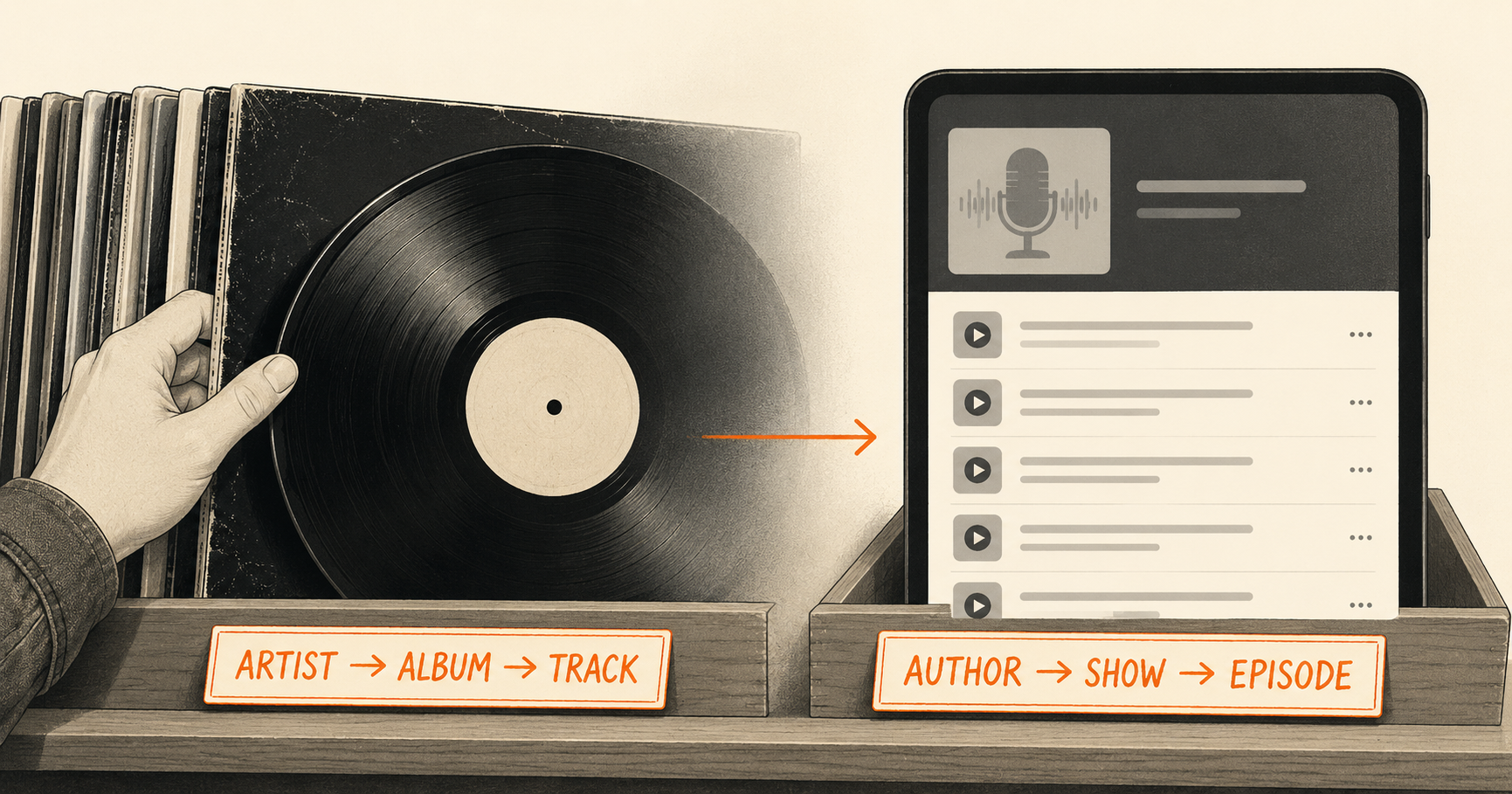
Type “Michael Jackson” into any music app and three layers of identity light up at once: the artist (Michael Jackson), the album (Thriller), the track (Beat It). All three are iconic. All three sing.
Apple Podcasts spun out of iTunes. Spotify launched as a music app and bolted podcasts on later. Their podcast search engines still carry that DNA. They’re built to navigate a world of artists, albums, and tracks.
But podcast identity is much weaker. The host usually isn’t a household name. The show title is rarely as iconic as Thriller. The episode title is nowhere near as recognisable as Beat It. So what happens when you point a record-store search engine at content that doesn’t behave like records?
We analyzed roughly 11 million top-5 (keyword, target) pairs on Apple and Spotify for a single day, 2026-05-04. The pattern that emerges is consistent: both engines are still doing what they were designed for. They just weren’t designed for this.
The album wins: how show titles dominate rank 1
If you check whether the searched keyword literally appears in a show’s name or author field, the rate at which it does is a good proxy for how much each platform leans on title metadata. Random pairing would match well below 0.001% of the time. Both platforms are massively above that.
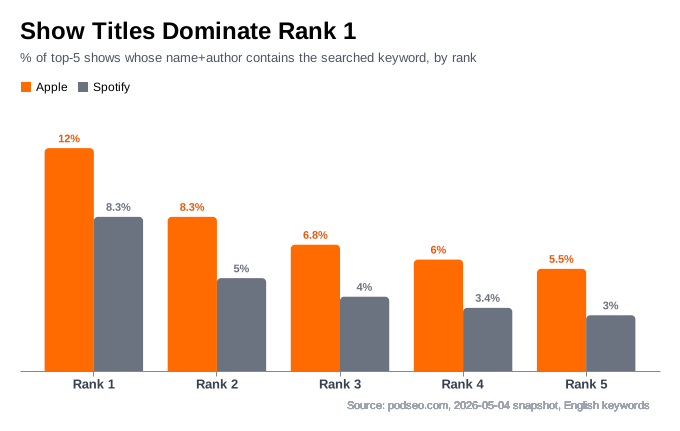
Both platforms reward title-stuffing at the show level. Apple is steeper.
- Apple, rank 1: 12.0% of top-1 shows have the searched keyword in their name+author.
- Spotify, rank 1: 8.3%.
- The rate decays smoothly as you walk down the page: Apple goes 12.0% → 8.3% → 6.8% → 6.0% → 5.5% across ranks 1–5; Spotify goes 8.3% → 5.0% → 4.0% → 3.4% → 3.0%.
That decay is the signal. Whatever both engines are using to break ties at the top, the show title field carries serious weight, exactly like a record bin labelled “Michael Jackson.”
Where Apple and Spotify part ways: the track problem
The more interesting divergence is one level down, at episodes, the “tracks” of this metaphor.
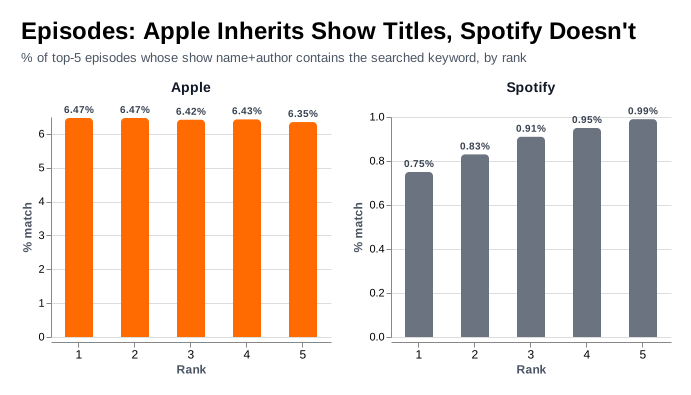
Apple’s episode ranker inherits show metadata. Spotify’s barely does, and what little it does is upside-down.
On Apple, 6.4% of top-5 episodes have the searched keyword in their show’s name or author, and the rate is essentially flat across ranks 1–5. The album’s label propagates straight to its tracks.
On Spotify, the same metric is only 0.75–0.99% (about 8× lower than Apple), and the curve is inverted. The rate is lowest at rank 1 (0.75%) and highest at rank 5 (0.99%). Whatever lifts an episode to the top spot on Spotify, it isn’t show metadata.
The mental model writes itself: Apple ranks tracks like B-sides of a hit album. Spotify ranks each track on its own merits.
The album-to-track lift, quantified
Same idea, different angle. Take all (keyword, show) pairs where the show ranks top-5. How much more likely is one of that show’s episodes to also be top-5 for the same keyword, compared to the baseline rate of any episode being top-5?
| Platform | Episode top-5 lift when show is top-5 |
|---|---|
| Apple | 3.3× |
| Spotify | 1.5× |
On Apple, an episode whose show is top-5 is 3.3× more likely to also be top-5 itself than the average episode. On Spotify, the lift is just 1.5×. Being from a hit album is a real boost on Apple. On Spotify, the album barely matters.
Recency: both stores love a new release
Now the most music-app-shaped instinct of all. We matched top-5 episodes back to their RSS publication dates and compared the age distribution of top-5 episodes to the catalog they were drawn from.
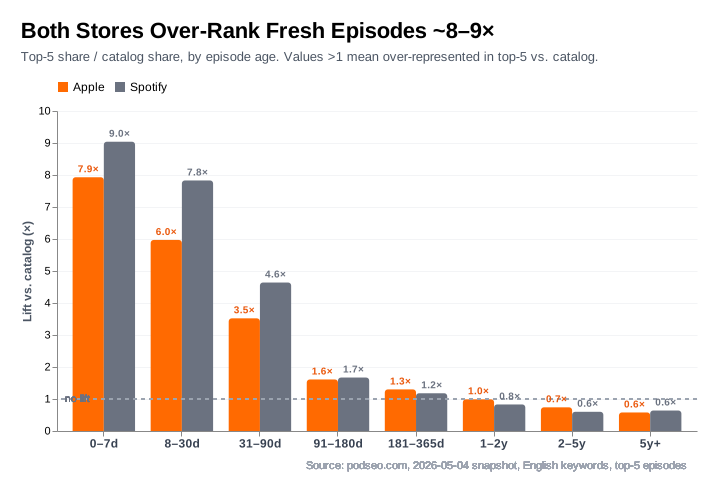
Both platforms over-rank fresh episodes ~8–9× and penalize anything older than two years.
- 0–7 days old: episodes are 7.9× over-represented on Apple, 9.0× on Spotify, vs. their share of the catalog.
- The boost decays smoothly through ~90 days, becomes neutral around 1–2 years…
- …then turns into an active penalty: 2y+ episodes show up in top-5 at only 0.6× their catalog share. They’re being suppressed relative to baseline.
This is the front-page-of-the-music-app logic, transposed onto talk content. It works fine for a daily news show. It punishes a five-year-old interview that might actually be the best answer to your search.
The keyword-stuffed mega-shows
Look at the leaderboard of which podcasts rank top-5 for the most English keywords on Spotify and a pattern jumps out:
| Show | Author | Top-5 keywords |
|---|---|---|
| The AI Daily Brief: Artificial Intelligence News and Analysis | Nathaniel Whittemore | 4,364 |
| Financial Coaching for Women: How To Budget, Manage Money, Pay Off Debt, Save Money, Paycheck Plans | Vanessa and Shana | 3,854 |
| Untangle Your Thoughts | Trust in God, Hear from God, Mental Health Tips, Negative Thoughts, Relationship with God, Christian Podcast… | Jessica Hottle | 2,935 |
| Mom Wife Career Life | Time Management & Work-Life Balance for Working Moms, Mindset, Healthy Habits, Positive Parenting | Kerri Patt | 1,994 |
These titles aren’t titles. They’re keyword lists pretending to be titles. The author fields are just as bad. One of these is “Christian Life Coach │ Spiritual Growth Mentor │ Christian Mental Health Coach │ Christian Counseling.”
This is what Michael Jackson would look like if he renamed himself “Michael Jackson, King of Pop, Pop Music, Soul, R&B, Thriller, Bad, Off the Wall, Beat It, Billie Jean” and put the album sleeve in 6-point type. The search engine isn’t being gamed. It’s being exploited exactly the way it was built to be navigated.
A short, well-chosen tagline after your show name is genuinely useful, and we recommend experimenting with one in both the title and the author field. “Lex Fridman Podcast: Conversations on AI, Science, and the Human Condition” is doing real work for both a human reader and a search engine. The cases above are different in degree: a title like “Untangle Your Thoughts | Trust in God, Hear from God, Mental Health Tips, Negative Thoughts…” stops describing the show and becomes a keyword list. That has two costs. First, ranking and converting are different problems, and a title that wins the search has to survive the half-second a real listener spends deciding whether to tap. Second, platforms can change the rules: Apple and Spotify both have precedent for de-ranking or truncating metadata that gets too obviously gamed. The line we’d draw is straightforward. Add a tagline. Experiment with what’s in it. But keep it something a human editor would let through.
The decoupling: most top-5 shows have zero top-5 episodes
The lift in the previous section was conditional. It only counted episodes from a top-5 show that were already tracked in the episode ranking. Now we ask the marginal question instead: for a given top-5 (keyword, show) pair, how many of that show’s episodes are top-5 for the same keyword at all?
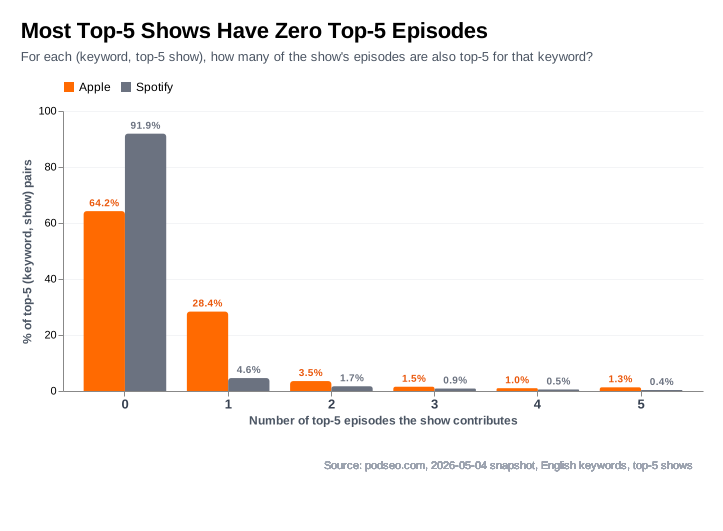
Most top-5 shows have zero top-5 episodes. Show ranking and episode ranking are partly different beasts, especially on Spotify.
- On Apple, 64.2% of top-5 (keyword, show) pairs have zero top-5 episodes for that keyword.
- On Spotify, it’s 91.9%.
In other words: most of the time a show is top-5 for a keyword, none of its episodes are top-5 for the same keyword. The show ranker and the episode ranker are looking at different things, even more so on Spotify, where they barely seem to talk to each other. The album is in the front display. None of its tracks are on the radio. And vice versa.
The two findings are consistent. When a show is top-5 and there’s also episode-level activity, that activity skews top-5 (the §3 lift). But that “and” only happens 36% of the time on Apple and 8% of the time on Spotify. The rest of the time, the show ranker reaches its conclusion without any concurrent episode signal at all.
So which signals matter, and where
| Signal | Apple | Spotify |
|---|---|---|
| Keyword in rank-1 show’s name+author | 12.0% | 8.3% |
| Show metadata propagates to episodes (top-5) | 6.4% (flat) | 0.9% (inverted) |
| Show top-5 → episode top-5 lift | 3.3× | 1.5× |
| Recency boost (0–7 day episodes) | 7.9× | 9.0× |
| Top-5 shows with zero top-5 episodes | 64% | 92% |
If we caricature the two algorithms:
- Apple behaves like “the album lifts every track”. Show metadata propagates, and recency adds a hefty boost on top.
- Spotify behaves like “each track stands on its own, and we like new ones”. Show signals barely propagate down, and recency does most of the work for episodes.
What this means for podcasters
- Your show name and author field are still your single biggest SEO lever on both platforms. But they’re a finite resource. You can’t stuff infinity, and the rank-1 lift only flows from one keyword at a time. Pick the one you actually want to win.
- On Apple, optimize the show. On Spotify, optimize each episode. Apple’s episode ranker borrows show signal heavily; Spotify’s mostly ignores it. If you’re on Spotify, your episode title and description carry weight your show metadata won’t carry for you.
- Publish often or fall off. A 9-day-old episode is already past its peak boost; a two-year-old episode is being actively penalized vs. the catalog distribution. Both engines treat “fresh” as a category, and there’s no equivalent of an evergreen ranking signal in this data.
Apple is still browsing the album shelf. Spotify is still scanning new releases. Neither was built for the way podcasts actually behave: long-form, host-driven, often evergreen, often best discovered by topic rather than by name. That mismatch is the entire reason podcast discoverability feels broken: the engines are doing exactly what they were designed for, just on the wrong content.
If you want to be found in 2026, you have to play the music game. Even if you’re not a band.
Methodology: single-day snapshot 2026-05-04, English keywords only, rank ≤ 5. Recency derived from RSS publication dates matched to top-5 episodes by title within each podcast.